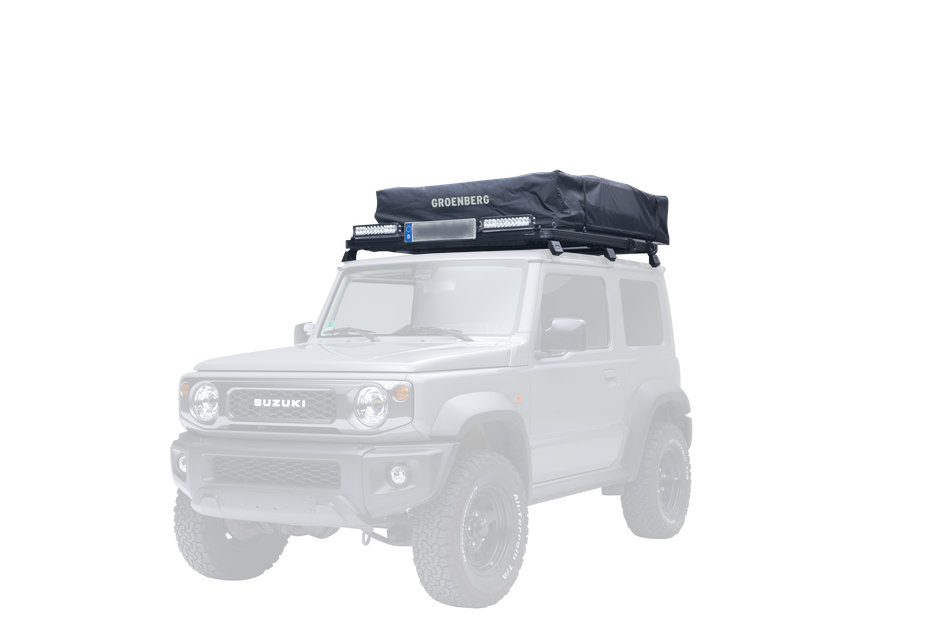
Reinforced cover, for the folded Groenberg Villmark, with a water column greater than 5000mm. The new cover is intended to protect the Groenberg Villmark even better, regardless of the type ...
Product available
This product is available and will be delivered within approximately 3-10 days.
Description
Information "Cover Villmark"
Reinforced cover, for the folded Groenberg Villmark, with a water column greater than 5000mm. The new cover is intended to protect the Groenberg Villmark even better, regardless of the type of weather. It also offers protection from branches that are accidentally brushed against. The double-sided TPU coating seals the tent cover from the inside and outside. No moisture gets into the roof tent. Attached with a piping rail, YNS zipper, extra long SBS zipper and 2x 1000D polyester tension straps, the tarpaulin sits securely even at high speeds. The tarpaulin can also be easily removed from dirt and insects.
Produktspezifikationen
| Color: | Black |
|---|---|
| Material: | 600D polyester double-sided TPU coating |
Reviews
Login
With the appropriate roof racks, our roof tents can be mounted on almost any car. (Convertibles excluded!) If you are unsure, please contact us by e-mail (info@groenberg.com) with as much of the following information as possible:
1. make, model name
2. year of construction
3. roof load (in the operating instructions)
4. roof rails yes/no?
To prolong the service life of the roof tent, it should be maintained regularly and cleaned when dirty. Firstly, the dried dirt should be carefully brushed off with a soft brush. The mattress cover can be completely removed and washed in the washing machine at 30**°** for easy care. The interior can be carefully vacuumed with a hoover or, better still, a hand hoover. Only then should mild detergent and a soft sponge be used. It is important that the roof tent is dried again before folding it up so that no mould can form. If mould does form, it can be cleaned with a mixture of water and vinegar. For particularly stubborn mould, please use a mould remover.
The roof tent should be stored dry and not closed. There is a risk of mould forming when it is closed. The tent must not be loaded during storage.
The recommended maximum speed of 120 km/h should not be exceeded. Please find out which legal regulations apply in the respective country before setting off.
No. Our roof tents are impregnated at the factory and can be used without pre-treatment. If the impregnation wears off after a few years, an impregnation protection, especially for roof tents, should first be tested on an inconspicuous area.
A few spare parts can be found in our shop.If something should break while travelling, our service team is on hand with advice and spare parts available at short notice.
Our telescopic ladders are 2.3 metres long.An extra long ladder (2.6m) can be ordered additionally.
Children love roof tents. For this reason, our roof tents are also suitable for children.
Both variants have many advantages, but also a few disadvantages.Here is a list of the most important ones:
**Softtop (folding roof tent):**
Advantages: significantly lighter than a hard shell, sleeping area doubles, usually covered entrance, usually cheaper price
Disadvantages: Usually takes longer to set up, not as aerodynamic, more susceptible to wind
**Hardtop (hard shell roof tent)**
Advantages: very quick to set up, more aerodynamic, significantly quieter when travelling, offers storage space for blanket, pillow, sleeping bag etc., more legal parking space options (tent does not protrude over vehicle)
Disadvantages: rather impractical for small cars as the footprint is too large, higher weight
Theft-proof nuts delay or even prevent theft, as the nuts can only be loosened with special tools. Another option is to attach a ring-head nut with a padlock to the screws. A GPS tracker can also be an advantage.
The roof load can be found in the owner's manual or can be obtained from the manufacturer. A distinction must be made between the dynamic and the static roof load.
The accessory articles can be found on the article page of the respective roof tent.
Our standard ladders are 2.3 metres long.For particularly high vehicles, we recommend our 2.6m ladder.
Depending on the model, the side walls may or may not be completely removable. This detailed information can be found in the product description of the roof tent.It can be recognised from the product photos.
Our roof tents do not have a power connection. We recommend using a power bank or a mobile battery.
As a standard, our roof tents are not equipped with built-in lighting. This allows you the flexibility to customize your setup to your specific needs. The Exceptions: Our premium models, Groenberg Alvar and Groenberg Tjelvar, come with an integrated lighting solution already installed for your convenience (dimmable LED light, USB port). Our Recommendation for all other models: To make your roof tent feel personal and cozy, we recommend using outdoor lamps or mobile fairy lights.
All the tools required to attach the roof tent to the roof rack are included.However, a ratchet spanner can make the work much easier.
Our pots and pans are made of cast iron.
Our pots have a small notch for a thermometer.
Cast iron is a material that produces reliable results on all heat sources, even on induction hobs and in any type of oven or grill.
Before using the Askja Pot for the first time, you should clean it thoroughly with soap and a sponge and then leave it to dry.
As soon as the pot is dry, it should be baked.To do this, rub the pot and lid with sunflower oil, rapeseed oil or coconut oil and bake it with the opening facing downwards at 200°C for about an hour until a black patina has formed. A gas grill with a bonnet or an oven is suitable for this. Please note that this produces a lot of smoke!
After slow cooling, the pot is ready for the first meal.
Provided the patina is not damaged, it is only necessary to bake it before using it for the first time.
For an even better patina, the Dutch Oven can also be baked several times.
To burn in, rub the pot and lid with sunflower oil and leave it to burn in with the opening facing downwards at 200°C for about an hour until a black patina has formed. A gas grill with a bonnet or an oven is suitable for this. Please note that this produces a lot of smoke!After slow cooling, the pot is ready for cooking.
Baking creates the patina, a natural non-stick coating, without any chemical additives.
The pot should be cleaned thoroughly with soap and a sponge before it is used for the first time and baked on. After that, no chemical cleaning agents should be used on/in the pot.
After use, you should only clean the pot (free of food residue) with warm water and a wooden or plastic spatula/spoon and then allow it to dry thoroughly. When the pot is dry, it should be wiped out with a little sunflower oil.
After cleaning, the pot should be wiped out with a little sunflower oil and can be stored dry with a double layer of wiping paper between the pot and the lid.
Please make sure that there is no oil in the pot, otherwise it could become rancid and have a negative effect on the flavour the next time you cook.
Larger rust spots occur if the pot has been stored too damp or the patina has been damaged.The rust spots can usually be easily removed with a steel sponge, warm water and a little soap. However, the pot must then be baked again.
Sunflower oil, rapeseed oil or coconut oil are best for baking.Cold-pressed olive oil, on the other hand, should not be used due to its low smoking temperature.
The glowing coals or briquettes are placed under and on top of the closed pot. Most of the heat should come from above and is distributed evenly over the whole pot by the cast iron.
The Askjy Pot should never be washed in the dishwasher.
After use, the pot (free of food residues) should only be cleaned with warm water and a wooden or plastic spatula/spoon and then left to dry thoroughly. When the pot is dry, it should be wiped out with a little sunflower oil and can then be stored slightly opened.
Cast iron is ideal for ovens.
Cast iron should not be moved on the hob to avoid scratches.
Before using the pan for the first time, you should clean it thoroughly with soap and a sponge and then leave it to dry.
As soon as the pan is dry, it should be baked.To do this, rub the pan with sunflower oil and bake it with the opening facing downwards at 200°C for about an hour until a black patina has formed.A gas grill with a bonnet or an oven is suitable for this. Please note that this produces a lot of smoke!
After slow cooling, the pan is ready for the first meal.
Provided the patina is not damaged, it is only necessary to bake the pan before using it for the first time.
To burn in, rub the pan with sunflower oil, rapeseed oil or coconut oil and leave it to burn in with the opening facing downwards at 200 degrees for approx. one hour until a black patina has formed.A gas grill with a bonnet or an oven is suitable for this. Please note that this produces a lot of smoke!After slow cooling, the pan is ready for use.
The pan should be cleaned thoroughly with soap and a sponge before using it for the first time and burning it in. After that, no chemical cleaning agents should be used on/in the pan.
After use, you should only clean the pan (free of food residue) with warm water and a wooden or plastic spatula/spoon and then allow it to dry thoroughly.When the pan is dry, it should be wiped with a little sunflower oil
After cleaning, the pan should be wiped out with a little sunflower oil and stored in a dry place.
Please make sure that no oil puddle forms in the pan, as this could otherwise become rancid and have a negative effect on the flavour the next time you cook.
Larger rust spots occur when the pan has been stored too damp or the patina has been damaged.The rust spots can usually be easily removed with a steel sponge, warm water and a little soap. However, the pan must then be baked again.
Sunflower oil, rapeseed oil or coconut oil are best for searing.Cold-pressed olive oil, on the other hand, should not be used due to its low smoking temperature.
The pan should never be washed in the dishwasher.
After use, the pan (free of food residues) should only be cleaned with warm water and a wooden or plastic spatula/spoon and then left to dry thoroughly. When the pan is dry, it should be wiped with a little sunflower oil and stored in a dry place.
A patina is a black coating that has a protective function for the cast iron pot or cast iron pan. It prevents rusting as the patina forms a barrier between the cast iron and the moisture in the air.
Cast iron is a material that produces reliable results on all heat sources, even on induction hobs and in any type of oven or grill.
The towels can be washed at a maximum of 40 degrees with a mild detergent.
The towels can be dried in a tumble dryer on a gentle setting. We recommend drying the towels in the air, e.g. on a clothes horse.
Please do not wash the towel above 40 degrees.Use the tumble dryer as rarely as possible. The towel should not be wet for long and should be dried as quickly as possible.
It is best to soak the grill grate in water with washing-up liquid or put it in the dishwasher. Stubborn dirt can be removed with a wire or grill brush.
Mix some washing-up liquid and warm water in a bucket and clean the grill with a soft cloth. To remove stubborn rust from the grill grate, you should brush the grill grate with a nylon grill brush to remove the rust spots. Only then should you use a rust remover specially designed for barbecues.
The frame has been developed in such a way that it also works wonderfully as a fire bowl.
Stainless steel discolours when exposed to heat, this is completely normal and does not represent a quality defect. You can counteract the discolouration process with a stainless steel brush and/or special grill cleaner for stainless steel grills.
No tools are required to assemble our barbecues. Our barbecues can be set up quickly by simply pulling them apart or folding them out.
The scale is sufficiently coated and therefore splash-proof.
The table should be cleaned with a soft cloth when dirty. If necessary, a mild detergent can also be used.
The table is designed for a uniform load of 30kg.
The table is protected against short-term wetness by its coating. However, we recommend storing the table in a dry place in the event of prolonged wetness.
The tarps should only be washed in the wool wash cycle if they are very dirty, at max. 30 degrees, using a gentle wool detergent and the lowest spin setting or crease protection.
It is best to dry the tarp on a line in the sun. The tarps are not suitable for tumble drying!
The tarp should be stored as dry and protected from the sun as possible.
Pegs are not included. You can find suitable pegs in our shop.
Guy ropes are included with the tarp.
Our tarps are impregnated at the factory and can be used without pre-treatment. If the impregnation wears off after a few years, we recommend using an impregnation protector for mixed fabrics, which should be tested on an inconspicuous area before application.
Our chairs are also suitable for children. Before each use, check that the chair is fully locked in place.
The Lagom is designed for a load of 130kg.
The Stjarna is designed for a load of 120kg.
The exact dimensions can be found in our pictures or in the product text of the respective item.
Due to the wide feet, the chairs can also be used on the beach.
Our T-Pegs pegs are suitable for all types of ground. Due to their special shape, they can also be hammered into hard ground.