In short
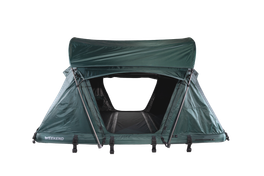
What a rooftop tent costs depends on its type, weight and features – and on the running costs. Heavy, permanently mounted rooftop tents need a car with plenty of roof load, a place to store them, and they ride on the roof all the time. The WEEKEND (11.5 kg) is our most affordable rooftop tent: it fits almost any car with roof bars, travels in the boot and is stored in a cupboard at home.
What does a rooftop tent really cost?
Anyone looking for a cheap roof tent looks at the price first. That depends mainly on the type: hard-shell rooftop tents with an aluminium shell take more to build than soft-shell models, and both weigh far more than an inflatable rooftop tent. Our own Alvar and Tjelvar hard-shell tents weigh 77 kg, for example, and the Halvor 160 soft-shell tent 68 kg.
The costs you only notice after buying matter just as much. A heavy rooftop tent needs a car with enough dynamic roof load, a place to store it, and it rides on the roof on every drive. So with the WEEKEND, "affordable" isn't just about the price – it's mainly about what you don't need: no bigger car, no garage, no permanent spot on the roof.
Affordable rooftop tents: the cost factors at a glance
Here's how the running costs differ between a permanently mounted rooftop tent and the WEEKEND – using our own models as examples.
| Cost item | Hard shell, e.g. Alvar (77 kg) | WEEKEND Classic (11.5 kg) |
|---|---|---|
| Car | Needs enough dynamic roof load for tent and bars – not possible on many small cars | Almost any car approved for roof bars, small cars included |
| Roof bars | Must carry the tent while driving too | Only carry the tent when parked; free for bikes or a roof box on the road |
| Storage | Space in a garage or cellar; taking it off needs help | Storage cupboard, packed size 75 × 48 × 40 cm |
| Fuel | Tent usually rides on the roof permanently | Tent travels in the boot – no extra cost from a rooftop tent on the roof |
| Sleeping base | Mattress included | Your own sleeping pad needed (not included) |
You'll find current prices for our models directly on the product pages of the WEEKEND Classic and WEEKEND Comfort.
On the road, the tent rides in the boot
The WEEKEND isn't made to travel on the roof. While you drive, it's packed in the boot. So there's no tent on the roof catching wind or making noise – just your roof bars, which you can take off completely between trips. Which roof load counts when is explained in our roof load finder.
Important
The WEEKEND is set up on the ground and then lifted onto the car as one complete unit. It comes back down before every drive – never drive with the tent on the roof, whether set up or packed.
A sleeping pad is not included. Pack your own.
No big car needed
The WEEKEND works with small or older cars too. The requirement is that your car is approved for roof bars and you have suitable bars. The tent is only on the roof when parked. Then the static roof load counts, and it is usually much higher than the roof load for driving, because a car roof also has to withstand a rollover. Still, check your car's static roof load and the load capacity of your roof bars – with you and your companion in the tent.
Polo, Corsa or an old estate – how much roof load small cars have is shown in our guide to the rooftop tent for small cars.
6 ways to save on your rooftop tent
Check the roof load first. If you want a cheap roof tent, check this up front – so you don't buy a model that later needs a bigger car or stronger bars.
Use the roof bars you have. If you already have bars for a bike or roof box, check their load capacity – they're often enough. What matters is explained in our guide to roof bars for rooftop tents.
Buy it together. Split the price with friends and pass the tent around. At 11.5 kg and a packed size of 75 × 48 × 40 cm, handing it over is quick. Four of you each pay only a quarter – every car just needs suitable roof bars.
Get double use out of your roof bars. Because the WEEKEND is only on the roof when parked, the bars stay free on the road for bikes, a canoe, a surfboard or a roof box. Our magazine article for cyclists shows how that works with a bike.
No car of your own? Use a hire car. Because the WEEKEND is so light, you can also use it on a hire car or car-sharing vehicle – as long as the provider allows roof bars. Ask first.
Only buy accessories you need. We only recommend the WEEKEND Bridge for 75–85 cm bar spacing, round bars or when two of you sleep in the tent. Everything else can be added later.
No big car, no garage, not even a car of your own if need be: the WEEKEND asks very little of your circumstances.
Affordable, not cheap and cheerful: what to know
An affordable rooftop tent should still be waterproof and well thought out. The WEEKEND has a tent made of ripstop polyester with a 5,000 mm hydrostatic head, aluminium poles, two entrances with mosquito nets and a dropstitch platform that supports up to 300 kg. Ladder, hand pump, carry bag and repair kit are included. To be honest, though:
- The tent has to come off the roof before every drive.
- The inflatable floor is a little less rigid than a metal frame; on multi-day trips you top up the air briefly.
- The tent fabric is thinner than on classic hard-shell rooftop tents.
- You bring your own sleeping pad.
FAQ: affordable rooftop tents
How much does a rooftop tent cost?
The price depends mainly on type, weight and features – hard-shell rooftop tents take more to build than soft-shell or inflatable models. On top of that come running costs for roof bars, storage and possibly fuel if the tent rides on the roof permanently.
Which is Groenberg's most affordable rooftop tent?
The WEEKEND Classic. It's our lightest and most affordable rooftop tent: 11.5 kg tent weight, packed size 75 × 48 × 40 cm. You'll find the current price on the product page.
What running costs does a rooftop tent have?
Typical running costs are suitable roof bars, a place to store the tent, fuel costs from a tent on the roof and possibly a car with more roof load. With the WEEKEND you only need roof bars and your own sleeping pad – the tent travels in the boot and is stored in a cupboard at home.
Do I need a big car for an affordable rooftop tent?
Not for the WEEKEND. It fits almost any car approved for roof bars, small cars included. It isn't on the roof while driving; when parked, the static roof load counts.
Can you share a rooftop tent?
Yes. The WEEKEND weighs 11.5 kg and fits packed in most boots, so it's easy to pass on. Every car just needs suitable roof bars.
Conclusion: affordable rooftop camping with the WEEKEND
An affordable rooftop tent isn't just about the price. With the WEEKEND, your car becomes a bedroom for two – without a big vehicle, without a garage and without a tent on the roof while you drive. It's our most affordable rooftop tent and disappears into a cupboard at home. All types of rooftop tent compared are in our rooftop tents category, and more topics in the Groenberg magazine.
WEEKEND Classic & Comfort
Two versions, one concept. Pick your way in.
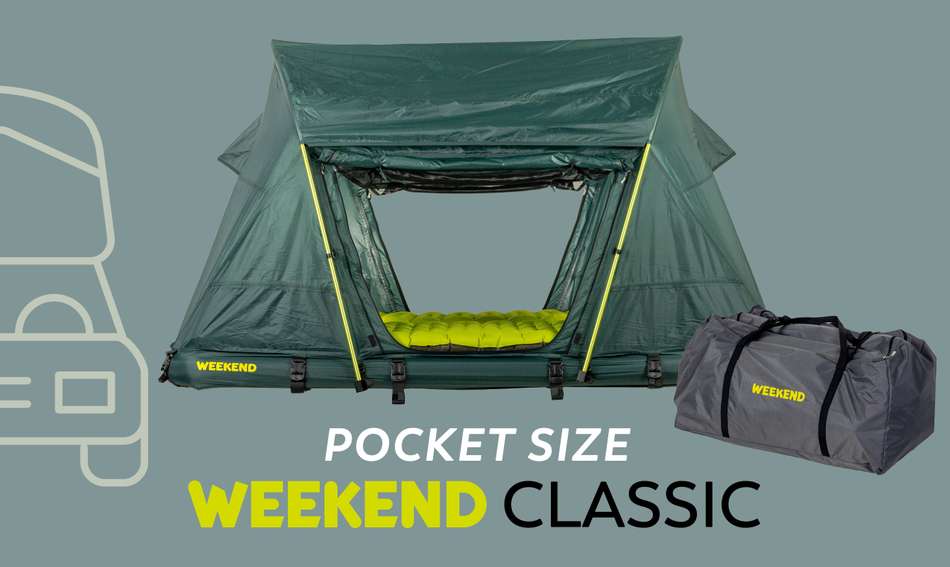
WEEKEND Classic
11.5 kg tent weight, packed size 75 × 48 × 40 cm, inflatable dropstitch floor. Our lightest and most affordable rooftop tent.
View the WEEKEND Classic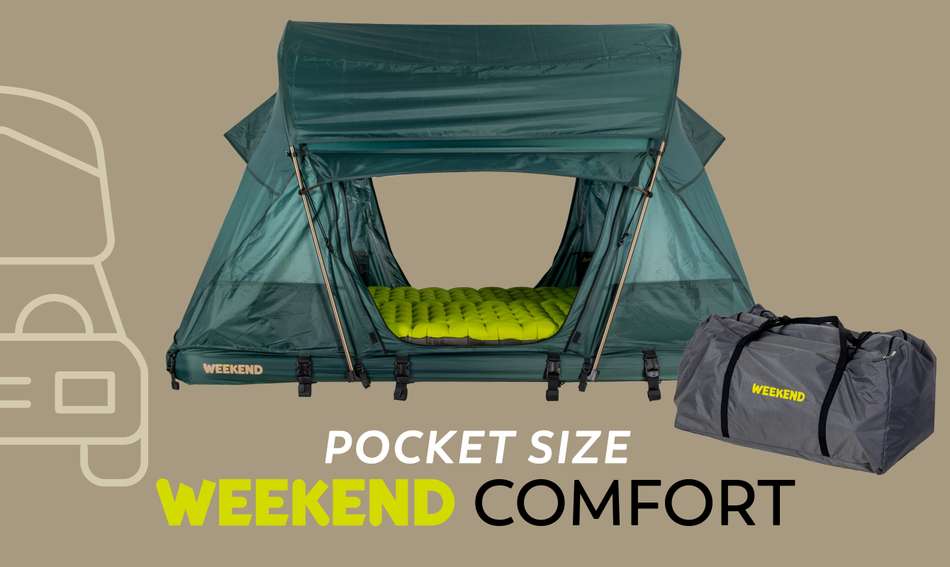
WEEKEND Comfort
13 kg tent weight, same packed size. Plus a SkyView roof with two panoramic windows, rain canopies over both entrances and a blackout coating.
View the WEEKEND ComfortDiscover all WEEKEND models
Ultralight, compact, for almost any car with roof bars.
To the WEEKEND rooftop tent