A rooftop tent on a small car – is that even possible?
The short answer: yes – with the right concept. Conventional softshell and hardtop rooftop tents stay on the roof permanently and weigh many times more than the WEEKEND – our own Halvor, Alvar and Tjelvar models, for example, weigh 68 to 77 kg. For a Polo, Corsa, Yaris or Golf with a dynamic roof load of 50–75 kg, that is often impossible or leaves no reserve. The WEEKEND solves this with a different approach.
The problem: small cars and roof load
Small cars often have a low dynamic roof load – the weight allowed on the roof while driving. That rules out many rooftop tents. The Groenberg WEEKEND avoids the problem because it isn't on the roof while you drive – it's in the boot. That makes it a good choice for small cars and vehicles with a low roof load – provided your car is approved for roof bars.
Which roof load values different vehicles have, and what to keep in mind, is explained in detail in our Roof Load Finder.
The WEEKEND travels in your boot. No tent on the roof while driving, no wind noise, no extra fuel use from a rooftop tent – until you reach your destination.
No permanent weight on the roof
Because the tent doesn't ride on the roof all the time, you avoid wind noise and extra fuel costs. It only comes into play when you actually need it – at your destination. There, you set it up on the ground, lift it onto the roof as one complete unit and you're ready for the night in a few minutes.
While you drive, only the roof bars are on the roof – so the dynamic roof load hardly matters. When parked, the static roof load is what counts: on most vehicles it is considerably higher than the dynamic value, because the roof is also designed for rollover protection. Still, before first use, check your owner's manual and the load rating of your roof bars – when parked, they carry the tent, the Bridge if used, and everyone sleeping inside.
Which small cars are suitable?
In principle, any vehicle approved for roof bars – whether a VW Polo, Opel Corsa, Toyota Yaris, Renault Clio or Ford Fiesta. Vehicles whose manufacturer doesn't allow any roof load are not suitable, for example the Smart Fortwo, the VW ID.3 or many models with a panoramic roof. You'll find the roof load figures in your owner's manual. If in doubt, our Roof Load Finder will help.
A pop-up camper in minutes
With the WEEKEND, even a small car becomes a pop-up camper in a few minutes – with a 220 × 130 cm sleeping area, comfortable for one and enough room for two. It is always set up on the ground, then you lift the complete tent onto the roof. Before you drive on, it comes back down. You don't need tools or a helper. Our Installation & Setup guide shows the process step by step.
Affordable rooftop camping with a small car
The WEEKEND isn't just made for small cars – it's also an affordable way into rooftop camping: a full-fledged tent that needs neither a big budget, nor a big car, nor a garage. You'll find more on value for money in our article for bargain hunters.
Conclusion: rooftop camping with a small car
The dream of rooftop camping is within reach for small cars too. The WEEKEND makes it possible – roof bars on, tent in the boot, off you go. You'll find more rooftop tent topics for different kinds of campers in the Groenberg Magazine.
WEEKEND Classic & Comfort
Two variants – one concept. For almost any car with approved roof bars.
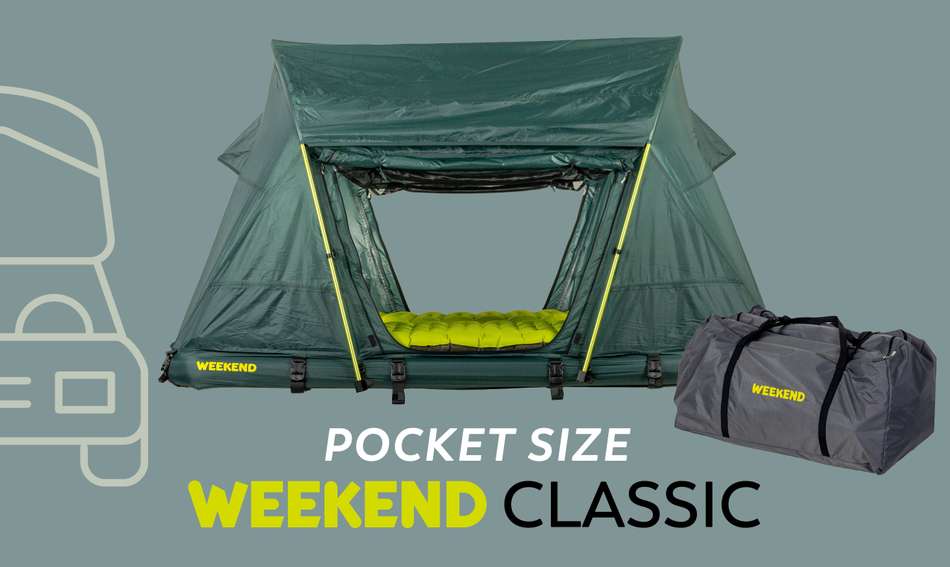
WEEKEND Classic
11.5 kg tent weight, packed size 75 × 48 × 40 cm, inflatable dropstitch floor. Currently perhaps the world's lightest rooftop tent.
View now →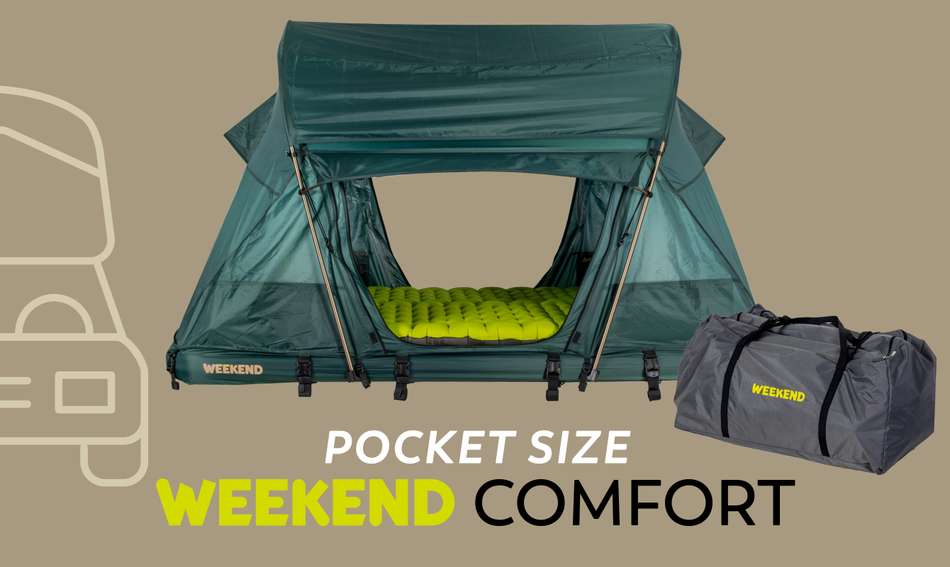
WEEKEND Comfort
13 kg tent weight, same packed size – plus SkyView roof, black-out coating and rain-protected entrances.
View now →Note: A sleeping mat is not included with either model.
Discover the Groenberg WEEKEND
Ultralight, compact, for almost any car with roof bars. Choose Classic or Comfort now.
To the WEEKEND rooftop tent →